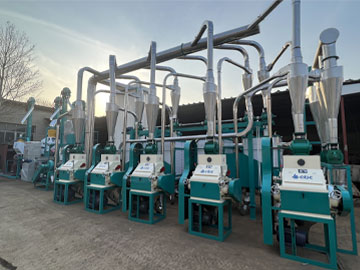
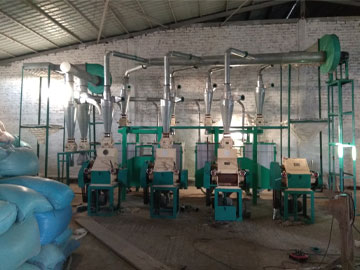
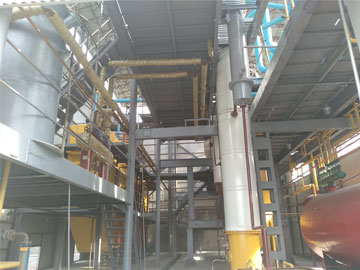
This 160 TPD wheat flour plant in New Zealand runs on a full-plant PLC system, from wheat intake through to a robot palletiser at the packing end. The building is a four-floor steel structure rather than concrete, which is what makes a six-month build possible at this capacity. Storage is sized for 1,000 tonnes of raw wheat.
| Project Name | 160 TPD wheat flour mill plant |
|---|---|
| Project Output | 160 tonnes of wheat per day, about 6.7 tonnes per hour over 24 hours |
| Project Position | New Zealand |
| Main Process | wheat cleaning, milling, sifting, packing and palletising |
| Control System | full-plant PLC, supervised from a computer control room |
| Storage | 1,000 t wheat, 210 t flour, 50 t bran |
| Build Time | about 6 months |
Three things separate this project from a standard 160 TPD mill: the control philosophy, the storage ratios, and the choice of a steel structure. Each one changes how the plant is operated rather than how much flour it makes.
Full-plant PLC. Starting and stopping sequences, roll gap changes and bin routing are executed from the control room instead of by hand at each machine. On a plant this size that removes most of the walking between floors that a manual mill requires.
Automated packing and palletising. The packing line fills, weighs and closes bags, and a robot palletiser stacks them. This is the section that usually limits output in a manually operated mill of this capacity.
Steel structure. Four floors of steel frame can be fabricated off site and erected in weeks, which is the main reason the whole project closed in around six months.
Raw wheat storage of 1,000 tonnes, against an intake of 160 tonnes per day, gives 6.25 days of running without a delivery. That number is the practical buffer against harvest timing, transport delays and wheat price movements, and it is the figure to compare when reviewing any mill proposal at this capacity.
Finished goods storage is deliberately shorter. Flour silos total 210 tonnes, about 1.3 days of production, because flour is dispatched continuously rather than held. Bran storage of 50 tonnes is sized to match the collection cycle for the by-product trade.


Silo Section of the Plant - 250 tonne wheat bins in four units, plus flour and bran bins.
Wheat cleaning removes stones, dust and foreign grain before the first break. The milling section uses pneumatic roller mills, and sifting is handled by plansifters with stainless steel piping through the spouting runs.
Pneumatic roller mills lift and cool the stock with air rather than relying on gravity alone, which keeps the grinding zone at a stable temperature and reduces the manual intervention needed on the roll stands. Plansifters separate the ground stock into flour grades and return the coarse fractions to the next break.

High square plansifter

Pneumatic roller mills

Purifier

Wheat threshing PLC control

Air-suction pipeline

Electric screen


Flour Tank

Wheat flour in bags and manipulator
A four-floor steel structure has to be ordered to the mill diagram, because floor heights and opening positions are set by the spouting and the machine layout. Changing the structure after the diagram is fixed is the most common cause of delay on projects of this size, which is why the layout is frozen before fabrication starts.
The connected electrical load for this plant is determined by the final machine list and the local supply arrangement, and it is confirmed at design stage rather than assumed from the daily capacity. If you are planning a plant at a similar capacity, the figures worth fixing early are the wheat storage days, the finished goods silo size and the packing rate.
The six months covers drawing approval, steel fabrication, shipping, erection, wiring and commissioning. Where a project runs longer, the delay is almost always in civil works or in the power connection rather than in the milling equipment.If you are planning a wheat flour mill in the 100 to 200 TPD range, send us your target capacity, the wheat storage days you need and your site constraints, and we will come back with a layout and a machine list for comparison. Contact us for more information.The equipment behind this plant is listed under flour milling equipment, and other plants in the same series are on the projects page.
ABC Machinery built a complete 100 TPD soy protein isolate line in Uzbekistan: pretreatment, low-temperature extraction, purification and spray drying....
Recently, the mayor of a city in Zimbabwe visited a local maize processing plant project. The plant is the latest cooperation project between ABC Machinery and our Zimbabwean client. All the highly efficient maize mill machines for the maiz...
Zambia 2024 is coming up with AGRITECH EXPO ZAMBIA exhibition at GART Research Centre, Chisamba (April 18th to April 20th) . ABC Machinery will be participating in this years Exhibition. We cordially invite you to visit our booth (A19) and...