Corn coming off the field at 25 to 30% moisture cannot be stored and cannot be milled. It has to be dried down to 13 to 15% first, and how that is done decides whether the grain still yields flour when it reaches the mill.The machine that does this work is a recirculating batch dryer. In this article, we will introduce how a 20-ton batch dryer is arranged, the settings that matter during operation, and what a recent overseas installation showed about running one. If you are setting up a corn mill and need to bring wet grain down to a safe milling moisture, this will help you make a wise investment decision.

Click to see the complete corn milling process step by step>>
The work carried out in a batch dryer consists of moving grain repeatedly between a tempering section and a drying section, which can be achieved using a bucket elevator, a belt conveyor and a centrifugal fan, such as the arrangement described below.
In addition, holding the moisture gradient even across the batch is one of the important steps in the drying process, and proper tempering ensures optimal processing of the corn during the later milling stage.
In well-equipped corn mill plants, the drying section also involves dust collection and separate temperature control for grain and air.
Some Corn Drying Machines For Sale( Of course they can also be used to dry wheat, paddy and other grains)
ABC Machinery is your trusted experts in grain processing equipment manufacturing. Whether you're looking to process corn, wheat, cassava, or any other grains, we offer perfect corn processing machines and comprehensive turnkey project services tailored to your needs.

While there is no set pattern to the layout of a batch dryer, a typical machine should include the following parts and corresponding equipment. (Click to view some models and details of grain cleaning equipment, and you can choose you are satisfied with.)

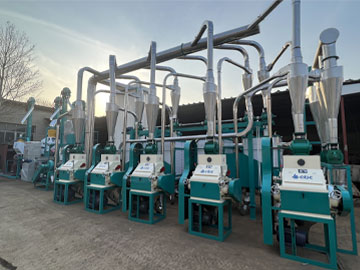
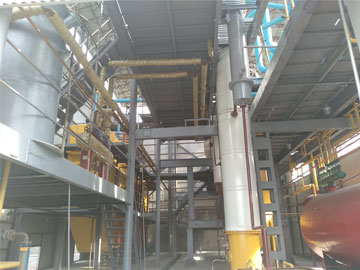
Dryer bodies under the canopy, and the inside of the drying section
Grain enters the hopper and is lifted by the bucket elevator into the main body, filling the tempering section and the drying section. In the tempering section, moisture migrates from the centre of each kernel toward the surface, which equalises the moisture difference inside the grain before the next pass.
Grain then moves down into the drying section. Air heated by the hot-air furnace is delivered by the centrifugal fan through the hot-air ducts and passes through the grain bed, heating the grain and carrying moisture away. Moisture-laden air and exhaust gas leave the machine through the dust-collection chamber.
The discharge section releases grain continuously into the lower hopper, from which the bucket elevator lifts it back to the tempering section, or discharges it directly once the grain is dry enough. When the target moisture is reached, grain leaves through the discharge hose at the top of the elevator.

Recirculation belt conveyor and its drive unit
In the operation of a batch dryer, must be based on the incoming moisture of the corn, and combined with the target storage moisture, the ambient humidity, the fuel type and the batch size for comprehensive consideration.
| Parameter | Setting | Note |
|---|---|---|
| Batch size | 15 – 20 t | 20 t machine; below 15 t the grain bed is too thin |
| Discharge speed, loading | 10 | Set before grain enters |
| Discharge speed, unloading | 50 | Raise gradually, do not jump |
| Cooling time | At least 100 min | Burner off, recirculation kept running |
| Moisture test interval | 20 min | Sample rests 10 min before measuring |
| Fan start to ignition | About 1 min | Wait until airflow is steady |
| Ignition to loading | About 1 min | Confirm at the burner viewing window |
Start the fan first and wait about one minute until it runs steadily, then switch on the burner and allow about one minute for ignition. Confirm ignition through the burner indicator and the viewing window before walking away.
The control cabinet carries three separate meters: grain temperature, air duct temperature and discharge.

Control cabinet: unpowered, and running
Test moisture every 20 minutes at the beginning. Let each sample stand for 10 minutes to cool before measuring, and test at least three times in succession as the reading approaches the target, because a warm sample reads high.
When the corn reaches the required moisture, switch off the burner but keep the machine recirculating so that cold air passes through the batch. Cooling must last at least 100 minutes. Discharging hot grain into a bin produces condensation on the grain surface and undoes part of the drying.
Increase the discharge speed gradually rather than jumping straight to the maximum, and keep the discharge pipe clear. When the bucket elevator is empty, stop it last.

Wiring terminal block, and the centrifugal fan
| Component | Interval | Action |
|---|---|---|
| All bearings | 100 h | Grease |
| All bolts | 100 h | Check tightness |
| Discharge and elevator gearbox | 300 h | Check oil level |
| Conveyor gearbox | 500 h | Check oil level |
| Fan bearing housing | 500 h | Check oil level |
| Fan motor bearing | 2,000 h | 40 ml lubricant |
| Foundation | Every startup | Check for cracks or tilting |
How to optimize the drying process based on incoming moisture?Corn at 25 to 28% generally needs several recirculation passes before it reaches the target, while corn already below 20% may reach 14% in fewer passes. The batch size and the discharge speed are the two levers an operator has.
A 20-ton fixed batch dryer was commissioned in 2026 for a corn mill handling field corn at 25 to 30% moisture and requiring 13 to 15% for storage and milling.

Two dryer bodies, and one being lifted into place
The installation followed the usual sequence: foundation and canopy first, then the dryer body and elevator, then the fan, furnace and ducting, then wiring and commissioning. Training covered loading, ignition, moisture testing, cooling and discharge, with the operator workbook left on site.
The first was fuel. The burner supplied was configured for diesel while the customer's site ran on natural gas, so the burner had to be changed before commissioning could start. Telling the supplier the fuel type at the quotation stage is cheaper than discovering it on site.
The second was batch size. The customer had only 8 t of corn available during commissioning, against a machine rated at 20 t. Below about 15 t the bed depth is insufficient and the batch cannot be dried to specification, so the run had to wait for more grain.

Installation site, and corn after drying
When using corn drying equipment with good quality and high efficiency, the number of recirculation passes can be appropriately reduced, or a larger batch can be handled in the same body.
When the equipment efficiency is poor, the drying process should be strengthened or a lower batch size should be adopted, and the rated capacity of a batch dryer is normally reached at 70 to 80% in actual production.
ABC Machinery's corn processing machines combine advanced technology with reliable design, using high-standard materials and manufacturing processes, and is committed to providing users with excellent performance and efficient operating experience. If you plan to start a corn mill plant business, contact us for more professional information!
For example, in the cold climate, the dryer needs a canopy or a building over it and the discharge pipe needs insulation to prevent condensation; in the humid climate, the cooling stage must be long enough for the batch to reach ambient temperature before it goes into the silo.
The structural choice made at the start also limits the later options. A steel canopy over an outdoor dryer is cheaper and faster to erect than a building, and it can be extended when a second dryer is added.
The drying machine is the first piece of equipment a corn mill depends on, because wet grain cannot enter the mill at all. If you plan to start a corn milling business, it is important to choose a professional grain processing equipment manufacturer/supplier.
ABC Machinery's product range covers 1 to 1,000 tonnes per day for corn, wheat and rice. The dryer is sized against the same flow sheet as the cleaning line and the mill, so the batch size, the silo volume and the milling rate are fixed together. (See More Details: ABC's complete corn milling equipment for sale>>)
No matter what the customer's needs are, our company is committed to providing high-quality, high-performance grain processing equipment to create greater value and competitive advantage for customers.
Equipment and operating parameters from the 20-Ton Grain Dryer Operating Instructions and the project commissioning record, 2026. Batch size, cooling time and maintenance intervals are the values specified for that machine.

ABC Machinery built a complete 100 TPD soy protein isolate line in Uzbekistan: pretreatment, low-temperature extraction, purification and spray drying....
Recently, the mayor of a city in Zimbabwe visited a local maize processing plant project. The plant is the latest cooperation project between ABC Machinery and our Zimbabwean client. All the highly efficient maize mill machines for the maiz...
Zambia 2024 is coming up with AGRITECH EXPO ZAMBIA exhibition at GART Research Centre, Chisamba (April 18th to April 20th) . ABC Machinery will be participating in this years Exhibition. We cordially invite you to visit our booth (A19) and...