Wheat, maize and rice can all be ground into flour. The difference is not grinding capability but the cleaning logic, whether husking or degerming is required, the flow complexity, and the by-product structure. A project planned on the wrong structure will later need process re-engineering, not just more flour milling equipment.This article compares the complete milling processes of the three grains, the key stage differences and the technical fit, so you can judge which route your raw material should take.
.jpg)
Many grain milling projects underperform after commissioning, and the root cause usually sits in the earlier selection stage. Below are the most frequent pitfalls, so you can avoid them at the process design and equipment matching stage.
Upgrading only the main machine while leaving the downstream stages untouched typically delivers only a fraction of the design target, with the bottleneck concentrated in sifting, dust collection and packing.
Wet processing requires steeping plus wastewater treatment and equipment investment of 60%-100% more than dry processing; the two routes cannot be converted into one another, so a wrong choice means rebuilding the line.
Moving from 100 mesh to 200 mesh raises specific energy consumption by 50%-120%; grinding temperature rises, starch damage increases and product quality declines.
Bran, germ, rice bran and maize fibre together account for 15%-35% of the raw material; without storage, conveying and sales planning, the supporting scope of the project is underestimated.
Note: the ratios above are experience-based reference ranges. Actual values must be calculated against raw material variety, process configuration and operating conditions.
Milling projects are normally planned in the following tiers, and the engineering requirements differ markedly from one tier to the next:
| Capacity tier | Typical form | Key engineering conditions |
|---|---|---|
| 10-20 TPD | Single or two-storey compact layout | Mostly manual feeding, simple dust collection, low demands on floor area and height |
| 30-60 TPD | Cleaning and sifting stages become independent | Pneumatic conveying and dedicated dust collection; building width must be reserved |
| 70-200 TPD | Multi-storey mill building | Floor-by-floor machine placement, finished-product bins, fuller control system |
| 200-500 TPD | Complete multi-storey line | Silos, centralized dust collection, automatic control and professional electrical design |
| 500-1000 TPD | Large-scale project | Full process design, project management and phased commissioning planning |
For most projects, the determining factor is not global output but the volume of raw material you can secure reliably over the long term.Not sure which capacity tier fits? Submit your project information to contact ABC Machinery. We do not start with a generic quote - we confirm the capacity basis and process route first, then define the equipment scope and quotation range.

All three grains go through cleaning and grinding, but their core systems are not interchangeable: wheat depends on multi-stage mill diagram grading, maize on dehulling and degerming, and rice on the grinding method that sets fineness.
Pre-treatment: cleaning (destoning, magnetic separation, scouring) → tempering (16-24 h hard wheat, 8-16 h soft wheat)
Break (fluted rolls, typically 4-5 passages): opens the kernel and scrapes off endosperm while keeping bran intact
Scratch (fluted rolls, tighter gaps than break): separates brany endosperm particles, keeps bran out of the flour
Reduction (smooth rolls, typically 6-9 passages): grinds clean endosperm into flour; sets extraction rate and flour colour
Tailings (roll type configured to suit the stock): recovers endosperm adhering to bran
Purification and sifting: plansifter + purifier + bran finisher
ABC Machinery: complete wheat milling equipment with mill-diagram design support; break, scratch, reduction and tailings passage counts and purification systems configured to your wheat variety and target flour grade.
Dry: cleaning → dehulling → degerming → breaking → grinding → sifting; products: maize grits, maize flour, germ, feed flour
Semi-dry: water addition → dehulling and degerming → grinding → sifting; higher purity, less dust
Wet: sulfur dioxide steeping → coarse grinding → germ separation → fine grinding → screening → starch/protein separation; products: starch, protein, germ oil, fibre feed
Environmental note: wet processing requires far higher investment and environmental control; wastewater is commonly underestimated
ABC Machinery: maize lines built around dehulling, degerming, grinding and sifting; dry and semi-dry configurations available, while wet milling is assessed case by case against the intended downstream product.
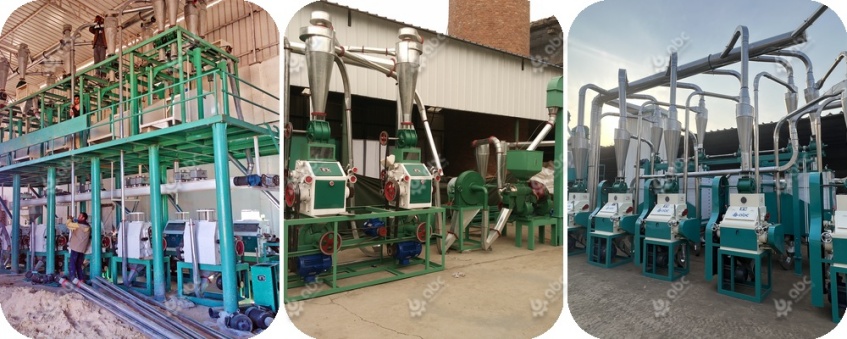
ABC Machinery Grain Milling Project Site and Equipment Installation
Prerequisite: husking first; raw material can be white rice, broken rice or brown rice, with broken rice the mainstream source
Dry grinding: grinding → sifting; high capacity, no water use, higher starch damage (reference 100-300 µm)
Wet grinding: grinding with water → dewatering → drying; finest particles (10-30 µm), lowest starch damage, high water use
Ultrafine grinding: jet mill / mechanical impact mill; starch damage rises with fineness
Selection: standard rice flour → dry; best mouthfeel rice foods → wet; rice milk and infant cereal → ultrafine
ABC Machinery: dry and wet grinding configurations for rice flour are available; ultrafine grinding requires confirming the end product and fineness target before the equipment scope is set.
Wheat, Maize and Rice Milling: Equipment, Site and Investment Compared
| Item | Wheat milling | Maize dry milling | Rice dry milling |
|---|---|---|---|
| Core machines | Roller mills, plansifter, purifier | Dehuller, degermer, roller mills | Pulverizer (hammer / turbo) or jet mill |
| Pre-treatment equipment | Cleaning equipment, water addition | Cleaning equipment, dehuller, degermer | Husker, cleaning equipment |
| Grading equipment | Plansifter + purifier | Sifting equipment (grits / flour grading) | Sifting equipment |
| Building structure / height | Multi-storey, vertical mill diagram, highest headroom | Multi-storey or compact single-storey | Mostly single-storey |
| Environmental focus | Dust control | Dust control | Dust control; wet route also wastewater |
| Main by-products | Bran | Germ, maize fibre, feed flour | Rice bran |
| Unit investment level (structural judgement) | Higher: multi-storey building + full diagram + purification | Medium: comparatively compact | Lower (dry); notably higher for wet and ultrafine |
| Additional investment variables | Silos, finished-product bins, graded-flour bins, controls | Germ collection and storage, controls | Drying system (wet route), wastewater treatment |
Note: the table gives structural judgements only. Investment per tonne of flour must be calculated for each specific project.
ABC Machinery has delivered turnkey wheat, maize and rice milling projects in multiple countries, covering Africa, Southeast Asia, Central Asia, the Middle East, South America and Oceania. Raw material characteristics, power supply and water conditions vary widely between regions, and the localised process experience gained from these projects is exactly what is used to avoid the selection pitfalls described above: upscaling the main machine alone, confusing dry and wet processing, uncontrolled energy consumption in ultrafine grinding, and missing by-product provisions.
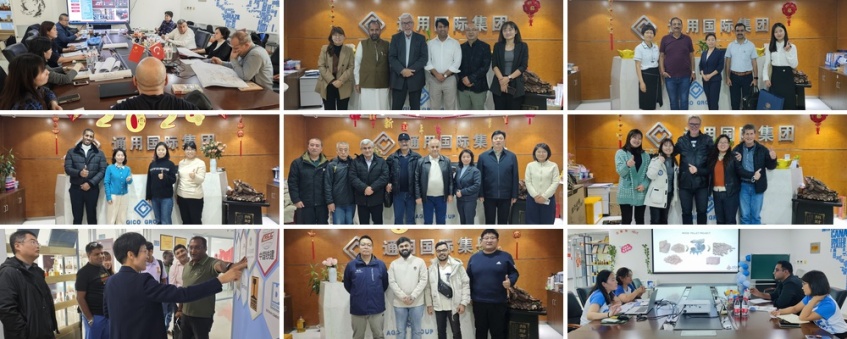
International Customer Visiting Our Group for Flour Mill Machinery Cooperation Discussion
We do not simply supply individual machines,we deliver complete line engineering adapted to local operating conditions, to stabilise product quality, optimise extraction rate and control specific energy consumption. Whether you are buying a single machine, building a new line or upgrading an existing plant, you can submit your project information at any time to obtain real project references, an independent process assessment and a budget range.Tell us your raw material and target products, and our engineers can assess the process route, equipment scope and investment level that fit your project.
ABC Machinery provided a complete 100 TPD soy protein isolate production line for a soy protein isolate plant in Uzbekistan. The line processes Non-GMO soybean through five production sections pretreatment and dehulling, low-temperature ext...
Recently, the mayor of a city in Zimbabwe visited a local maize processing plant project. The plant is the latest cooperation project between ABC Machinery and our Zimbabwean client. All the highly efficient maize mill machines for the maiz...
Zambia 2024 is coming up with AGRITECH EXPO ZAMBIA exhibition at GART Research Centre, Chisamba (April 18th to April 20th) . ABC Machinery will be participating in this years Exhibition. We cordially invite you to visit our booth (A19) and...