Large-Scale Flour Mill Project Planning
Planning a flour mill in Pakistan involves a structured workflow that integrates market analysis, technical design, and financial modeling. For investors exploring a flour mill for sale in Pakistan, understanding the end-to-end planning process is crucial to ensure operational success and capital efficiency.
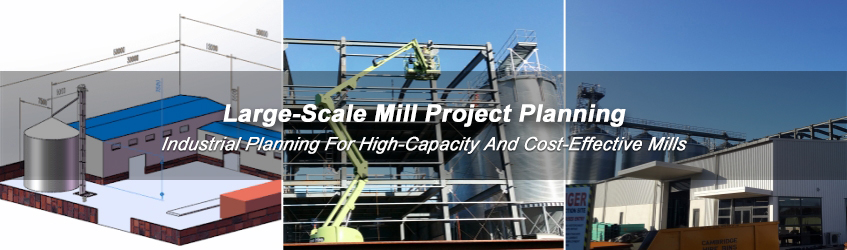
The standard planning process for large flour mills consists of five stages: feasibility study, project design, equipment selection, construction, and commissioning. Typically, such projects span 14–18 months, depending on capacity (ranging from 150 to 500 metric tons/day) and project financing.
Key steps in setup a flour mill plant project planning include:
During early project planning, using professional EPC (Engineering, Procurement, and Construction) partners like ABC Machinery ensures design accuracy and smooth execution from concept to commissioning. Project coordination is critical to avoid timeline delays and cost overruns. Integration between civil, electrical, and mechanical engineering teams reduces downtime during equipment installation.
Secure your project success with our turnkey flour mill planning and engineering solutions – connect with our experts today.

Designing a large flour mill process requires a systematic approach integrating raw material handling, cleaning, grinding, flour sifting, and packaging. In Pakistan’s competitive market, efficient layout design directly determines output consistency and operational cost.
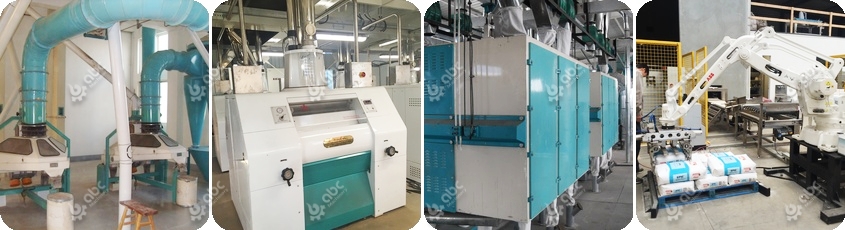
Key Processing Equipment in Each Flour Milling Process
A well-designed flour mill plant layout in Pakistan should minimize material flow distance (≤120 m total conveyor length). Energy efficiency is enhanced by integrating variable frequency drives (VFDs) and automated control systems (PLC/SCADA).
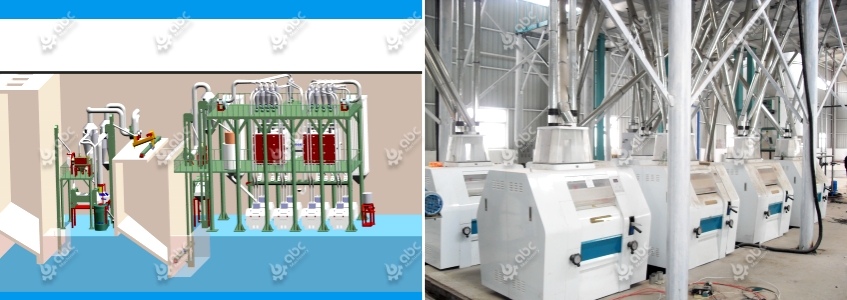
Wheat Milling Plant Layout Design and Factory Footage
| Section | Function | Recommended Area (m²) | Key Equipment |
|---|---|---|---|
| Cleaning & Conditioning | Prepares raw wheat | 400–500 | Aspiration, destoning units |
| Milling Hall | Core grinding process | 800–1200 | Roller mills, purifiers |
| Packaging & Storage | Final stage | 300–400 | Packing machines, silos |
| Control Room | Automation hub | 50–80 | PLC, monitoring systems |
Digital integration allows real-time monitoring of throughput, yield, and energy consumption. The use of MES (Manufacturing Execution System) enables production tracking with ±1% accuracy.
Implementing Industry 4.0-ready automation—combining PLC, SCADA, and NIR (Near-Infrared Reflectance) sensors—can boost production efficiency by up to 12% while reducing manual intervention by 25%. This digital integration ensures consistency across flour grades and enhances operational transparency for mill managers.
Unlock superior efficiency in flour production – contact our engineering team for customized process layout solutions today.
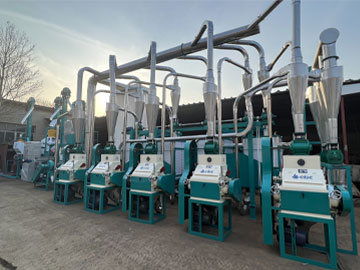
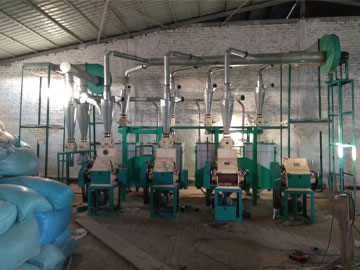
Selecting the right flour mill machinery in Pakistan determines performance stability and cost-efficiency. Core machinery includes roller mills, sifters, purifiers, pneumatic conveyors, and automatic bagging systems.
Typical large flour mills operate between 200–400 tons/day, requiring 8–12 roller mills and 4–6 purifiers for balanced throughput. Equipment durability (measured in operating hours between overhauls) should exceed 8,000–10,000 hours.
System integration ensures that mechanical and control components operate at synchronized speeds. A mismatch between milling and sifting capacity often leads to 3–5% yield loss, increasing costs.
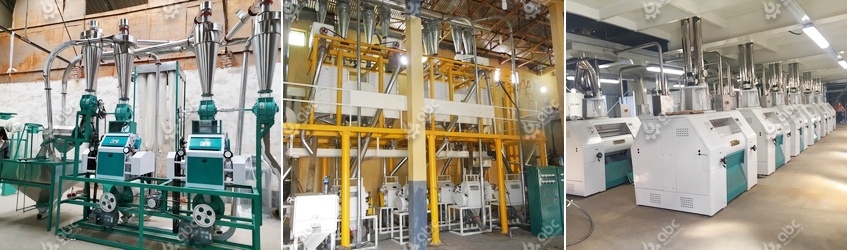
Selecting Right Capacity Equipment for Your Business
To optimize plant capacity:
Get your customized flour milling equipment selection and plant configuration plan – contact us now.

Efficient flour mill operation management in Pakistan relies on structured workflows, digital supervision, and preventive maintenance. Skilled operator teams (usually 1 per 30 tons/hour) are essential for maintaining smooth operations.
Key areas of optimization include:
Energy-saving flour production methods reduce cost per ton by 6–8% annually. Upgrading to high-efficiency motors and heat recovery systems can cut power usage to 1.9 kWh/ton.
Partner with us to develop a sustainable and energy-efficient flour mill operation strategy for long-term profitability.
flour mill in pakistan remains a cornerstone of the nation’s food processing economy. By leveraging advanced engineering design, modern automation, and robust management systems, every flour mill for sale in Pakistan can achieve higher productivity, quality assurance, and sustainable growth.

ABC Machinery provided a complete 100 TPD soy protein isolate production line for a soy protein isolate plant in Uzbekistan. The line processes Non-GMO soybean through five production sections pretreatment and dehulling, low-temperature ext...
Recently, the mayor of a city in Zimbabwe visited a local maize processing plant project. The plant is the latest cooperation project between ABC Machinery and our Zimbabwean client. All the highly efficient maize mill machines for the maiz...
Zambia 2024 is coming up with AGRITECH EXPO ZAMBIA exhibition at GART Research Centre, Chisamba (April 18th to April 20th) . ABC Machinery will be participating in this years Exhibition. We cordially invite you to visit our booth (A19) and...